Do not fear the momentum that sweeps you beyond immediate reality. Marble and bronze possess their own distinctive virtues, beyond the physical. The sculptor’s soul must harmonize with the soul of the material.
– Constantin Brâncuși
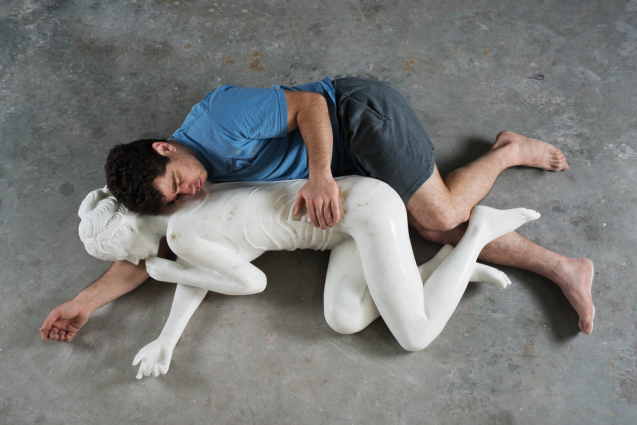
The exhibition New Materials brings together seven Israeli artists who have chosen to cultivate long-standing relationships with a primary material, present in their practice as an active, leading partner, one in which they have discovered the meeting point between heaven and earth, the spiritual and the corporeal. Through this encounter, they seek to illuminate and awaken the work with the material, proposing a model of ongoing intimate dialogue between the artist’s body and the medium employed. This chosen medium does not necessarily serve as a vehicle of expression, a conduit for ideas, or an inert mass into which they breathe life and form according to their will and imagination; it is an active entity, with intrinsic essence, a vital force in the creative process. While the material spectrum varies for each artist, they share an understanding that their material holds its own distinct temperament, desires, and properties. They share a similar experience of distilling its essence, touching on the existent and the space beyond.
This approach may be traced to the cradle of art: from Michelangelo, who believed in deep listening to the material’s inclinations, viewing the sculptor as one who reveals what already lies within the stone; to Brâncuși, who brough a deeper intimacy to this relationship, proposing that the artist not only extracts the image from the stone, but also reveals the harmony and spirit latent in the material. In the work of art, Brâncuși believed, matter and spirit intertwine: “What you anchor to the earth binds itself to the sky.”
There is a resonance, an affinity, in the artists’ accounts of their encounters with their chosen materials, in their search for a dormant physical and spiritual potential waiting to be awakened. It is a symbiotic relationship that demands from both the artist and the material learning time and technical mastery, alongside the ability to release control and attune to the personal experience underlying a creative process that rises from the surface; an experience that cannot be conveyed or sensed without insistence on touch, years of familiarity, and the courage to surrender. From these, as the artists attest, emerges a profound inner dialogue, endlessly examined and rediscovered.
The exhibition’s title, New Materials, seeks to perceive the material afresh; to point to the eternal return that occurs in the artists’ work with their respective medium. A broader view of the material’s metamorphosis in the universe reveals a circular process that began with the Big Bang. Since that moment, the universe’s mass and energy have remained constant, shedding and assuming form, each time taking on a different, transient configuration. A similar process unfolds in the studio. Every morning the artist reencounters the same old material, unearthing the primordial spark embedded in it since the universe’s dawn, and discovering infinite forms and identities within.
In his essays “The Thought of the Heart” and “Anima Mundi: The Return of the Soul to the World,” psychologist James Hillman strives to redirect our gaze to man’s interaction with the world. He suggests that the path to our inner selves passes through the understanding that every act we experience resonates with the essence of the act already present in the world, embodied in other elements, such as animals, plants, and material substances in the cosmos. Engaging with a mass that holds a material memory, perhaps even perception, thought, and feeling, as we experience, allows us to connect with it even more deeply, and thereby grasp the soul of matter of which Brâncuși spoke. Hillman proposes that we advance our relationship with matter—with the world—and perceive our dialogue with it as a connection of equals, rather than an exchange between operator and operated. Through this insight, we may meet ourselves and matter anew, and feel that our soul and the soul of the world are one.
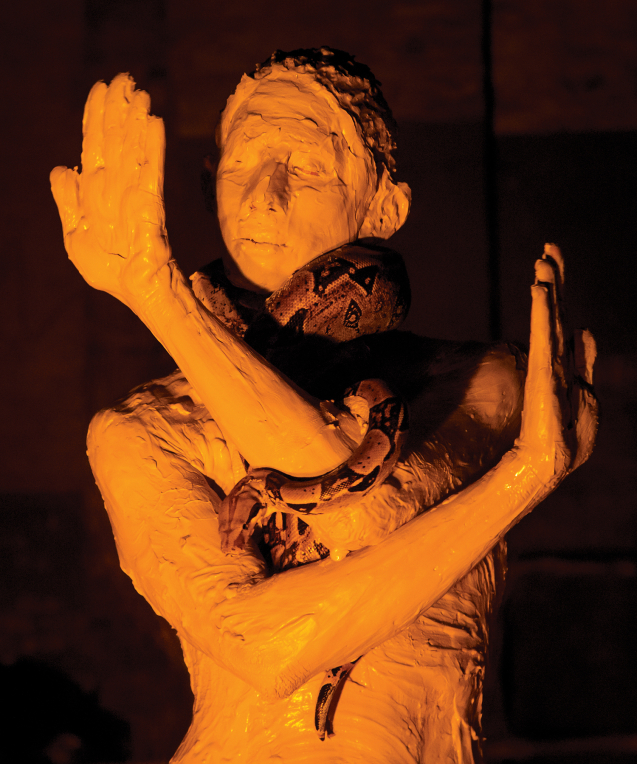
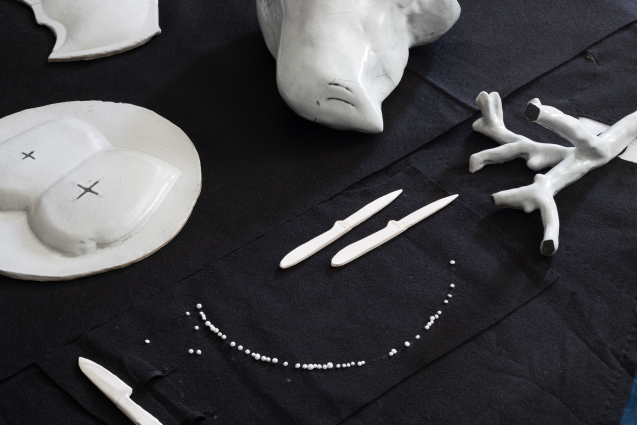
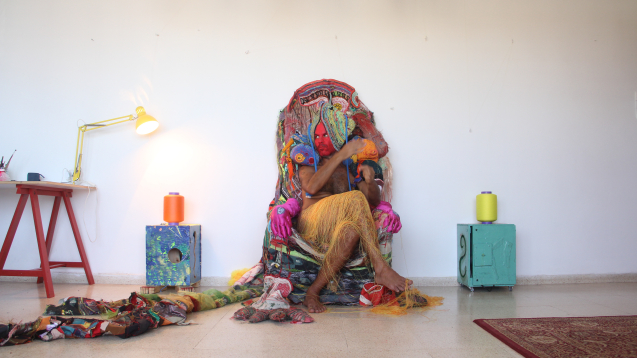
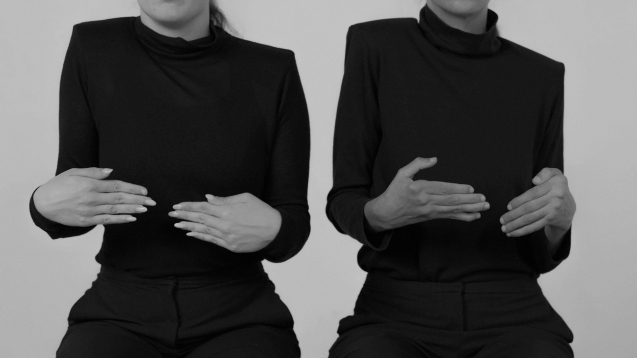
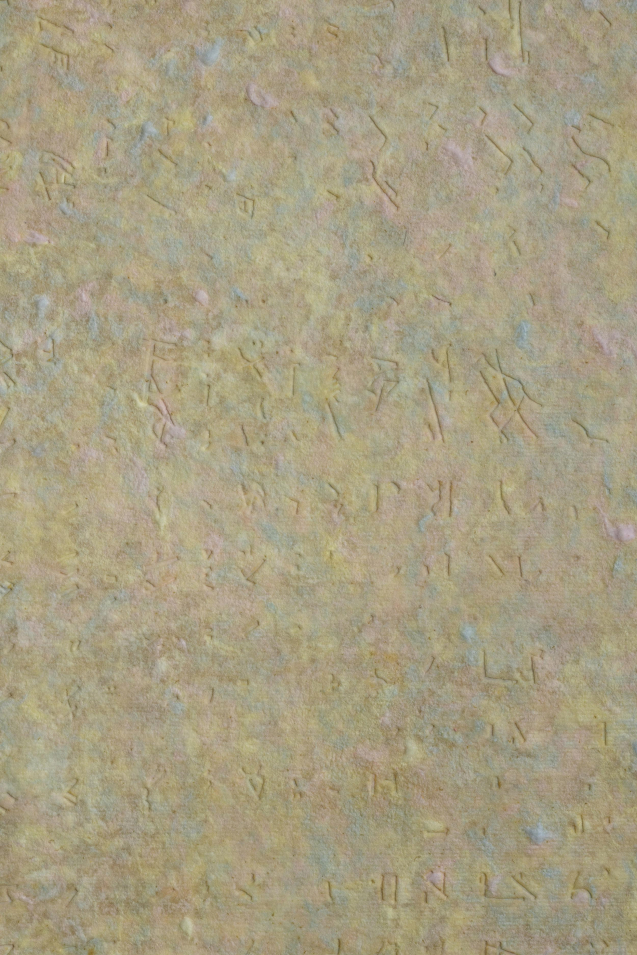
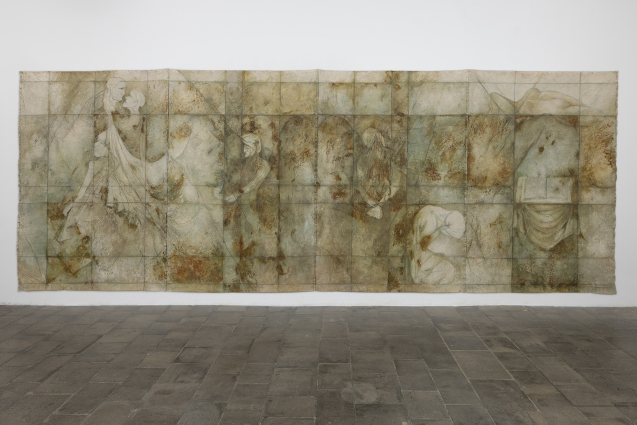
The works in the exhibition do not reduce reality to the medium from which they are made, but allow its conceptual and physical layers to draw on history, on past identities, and on the rebirth of the set of materials they comprise. The viewer thus encounters the works through a total experience: the ceramic objects emerging from the two-dimensional outline of Shahar Yahalom’s grandmother’s house façade fill the space with new life. Gal Weinstein’s expansive surfaces of steel wool and cotton wool reveal subtle traces, reminders of a wind that once passed, and will return. The tactile materials in Gili Avissar’s work carry a material memory of former works, while standing as new, autonomous presences. The historical sculptural sequence in Zohar Gotesman’s work seeks to establish linearity, echoing a human yearning to become part of a larger chain. In Lihi Turjeman’s canvases, the application and scattering of paint gives rise to archetypal images that surface into being. Ben Hagari’s desire to understand the material from within leads to his fusion with the clay. Chen Cohen’s internal metronome reminds her and us of the cyclical rhythm of heartbeats and the world’s pulse.
In these times, when the ground beneath our feet feels increasingly unstable, the need to return to the elemental, to the spiritual core of matter and being, grows ever more acute. Through sincere willingness to listen to the material’s source, physical work with the body it carries, and a new reading of the familiar, the artists furnish themselves—and us—with a perspective that transcends the physical limits anchoring us to the here and now. A dialogue with a material whose timeline is broader and more ancient than human history allows us to remember the primal, distilled, essential core, and to strive to rise beyond reality, to believe in the possibility of a more attuned present.
Read more