There is a moment that comes at the end of the night. The first light rises outside, but inside the club the music presses on. The bass syncs with the heartbeat, the body’s movements blend with other bodies, and the mind trembles between inside and outside—between the detachment indoors and the day breaking outside. The end of the party, the moment when the light pierces the darkness and darkness draws it back in, is the point of departure for Lali Fruheling’s “00:00″—a solo exhibition that looks at the end of the night as an existential state where it is impossible to tell between radiance and darkness, touch and loneliness, the party’s center and its margins.
The club allows those inside it to escape reality momentarily, to abandon the here-and-now in favor of an alternative present. The night ushers in another world, in which every movement, glance, or flash of light acquires a different meaning than it has in the world outside. Under the cover of darkness and loud music, the body is stripped of its mundane identity, and a new, temporary self takes shape. The partygoerceases to be a distinct “I,” becoming one with the experience of the club, and at its climax enters a pure sensory present. Not only does the body lose its stability, but time too floats and changes like a heartbeat—accelerating and then settling, pausing and then erupting once more. Within all of this, a space is created in which one can reimagine oneself: surrender, dissolve, and be reborn in the blink of an eye.
In phantasmagoria—magic and illusion shows popular in the 18th century—images were projected onto smoke to create a deceptive experience in which reality blends with illusion. Walter Benjamin borrowed the concept of “phantasmagoria” for his analysis of the modern city and the way in which commodities, fast pace, crowds, architecture, and passions appear as a seductive illusion, swirling into a continuous collective daydream that conceals its underlying power mechanisms. The club is designed to offer us a multisensory experience. From the disco ball to the dance floor, from the bar to the movement of the crowd in the various rooms—everyday reality is suspended, and one is drawn into a place where the “real” and the “staged” briefly converge. It is a magic that combines both promise and rupture: a sequence of flickering moments, appearing and fading before they can be truly grasped; moments that most of the time manage to conceal the dirt strewn on the floor.
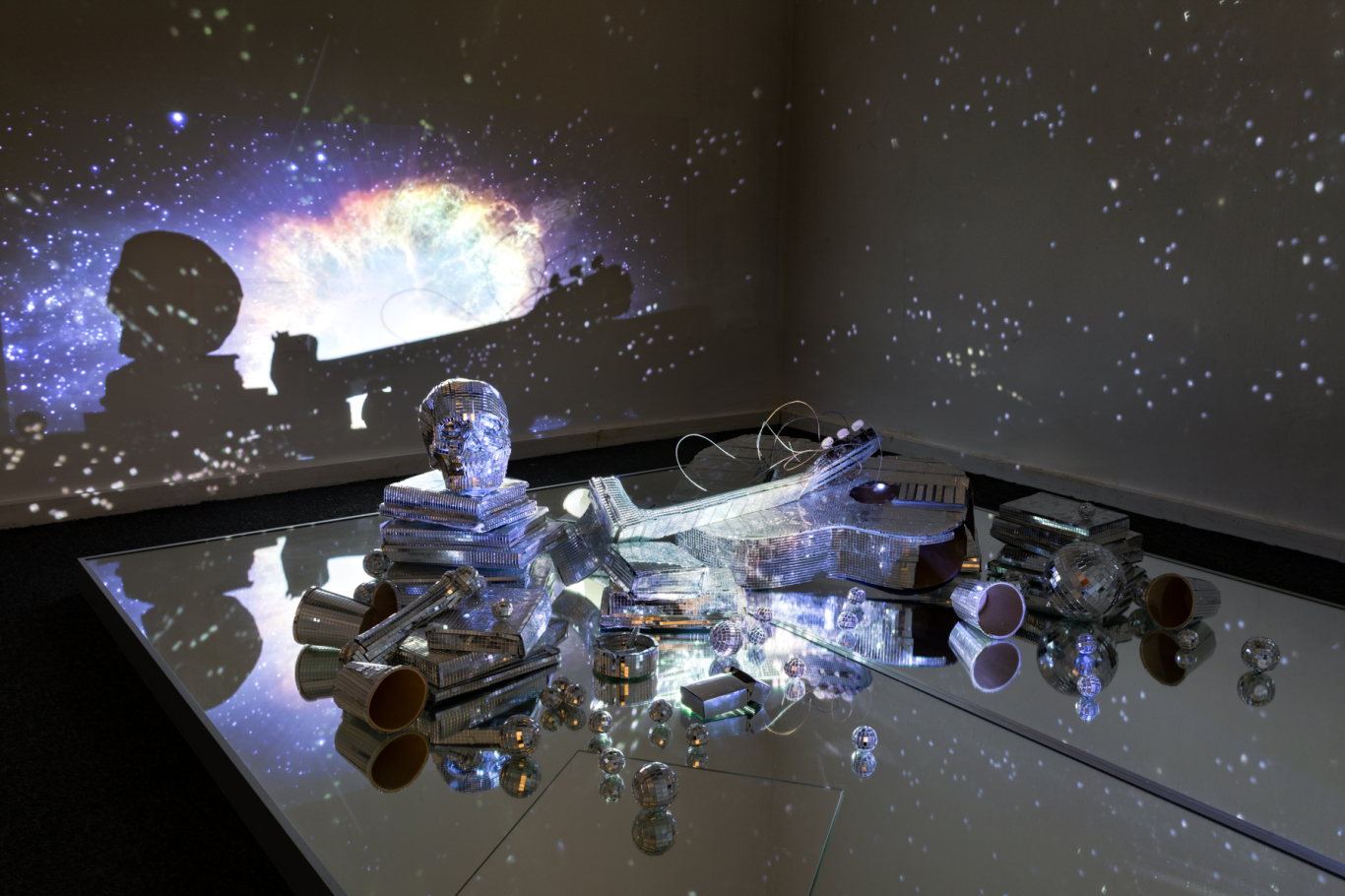
Like wandering through a club with several rooms, each with its own aesthetics, sound, and temperament, the transition between the different parts of the exhibition is one between different rhythms and realms of consciousness, that linger beyond the party’s end. A wax band setup is featured in the center of the space, a moment after the performance, suspended between playing and falling apart. A material that responds to heat and time, the wax functions as an exhausted body: it remembers the effort, the noise, the tension. It is as though the music itself played through it and then abandoned it to a slow melt. The guitar neck is broken, the instruments liquefy into themselves. As if the end of the night does not occur outside the space, but within the material itself.
Between drinks and flirting hands, two silicone human figures collapse at night’s end, their bodies seemingly fallen out of rhythm—one white and the other black; two poles holding a split in their very bodies, positive and negative. The visible body and the body that disappears into the darkness; the body that continues to dance and the body that has already lost the beat. Another realistic sculpture depicts the head of artist and musician Ohad Fishof, like a sound severed from time—a last echo of night, remaining in the air even after the body is gone.
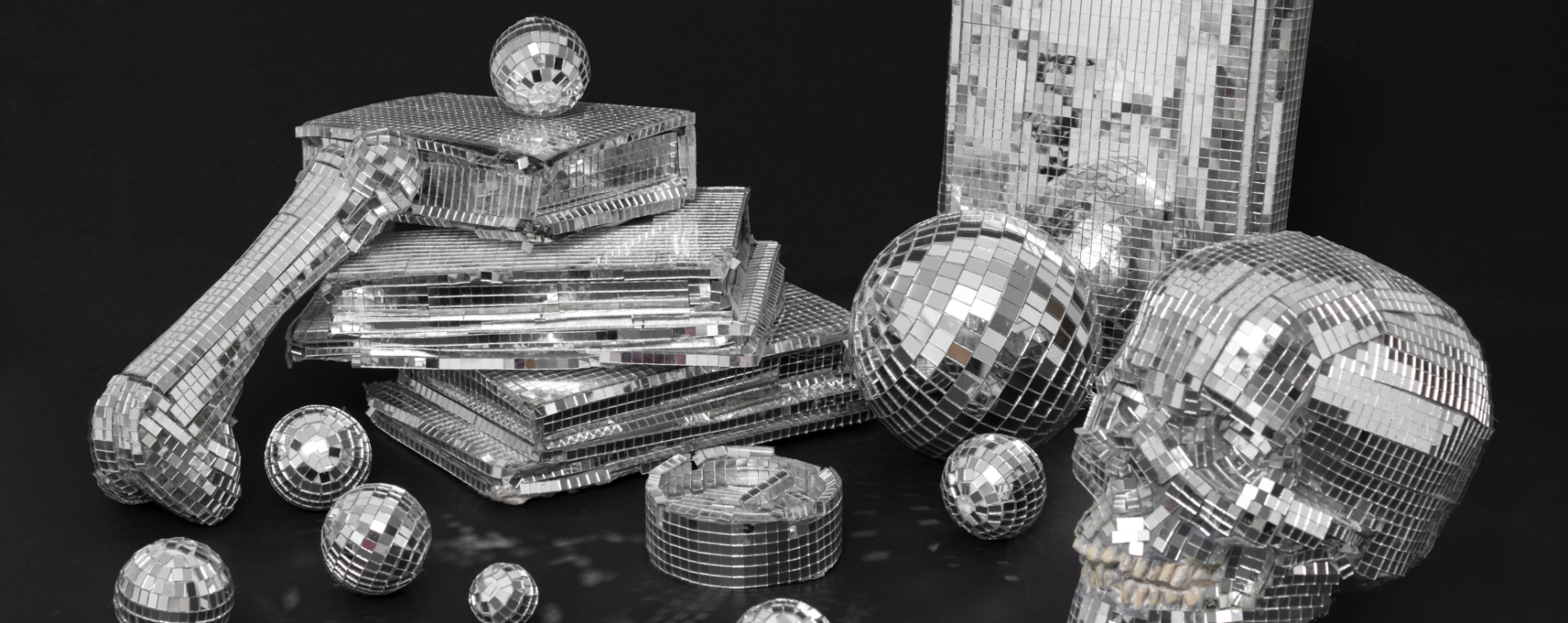
The fragility of life and the passage of time, represented in classic vanitas paintings by a skull or a fading candle, take on a nocturnal, glamorous form in Fruheling’s work. The still life in the exhibition—aguitar, a skull, an ashtray, and books—is entirely covered in tiny disco-ball mirrors, which attest above all to the brittleness of the moment. Each flash of light reflected from them is like a brief spark of memory: slightly sweet, slightly painful, and only as deceptive as necessary. That memory, the attempt to hold on to it, the desire to create it, accompanies the experience of the night as well as the exhibition. If we look closely, perhaps as the night wanes we will be able to glimpse the next party.
“00:00” opens on December 31, 2025, the night when one year ends and the next begins, a moment when fatigue and anticipation coexist, as in a turbulent night. Between these times, between who we wereat the beginning of the evening and who we are at the end of the year, we can only hope that, in those last instants before the sun rises, something new will come into focus.
Read more